


On this page
The short answer
- The trailer's payload must cover your load. Payload is the trailer's gross weight minus its unladen weight. Include everything you put on it.
- Your vehicle must be allowed to tow the loaded trailer. Check its towing limit and its gross train weight.
- Your licence must cover it. Licence from 1 January 1997 onwards: a trailer of up to 3,500 kg maximum authorised mass. Before 1997: usually a vehicle and trailer of up to 8,250 kg combined.
Three weights on every trailer
Every trailer has three weights. They are in the specification for each model, and the gross weight is on the trailer’s type plate, on the drawbar just behind the hitch, on the offside.
- Gross weight
- The most the trailer may weigh with its load. Also called the maximum authorised mass (MAM). This is the figure your licence goes by.
- Unladen weight
- What the trailer weighs empty, as it leaves the factory.
- Payload
- What you can put on it: gross weight minus unladen weight.
Every accessory you add, such as a ladder rack or a spare wheel, adds weight to the trailer and comes off the payload. So do straps, chains and anything else that travels with the load.
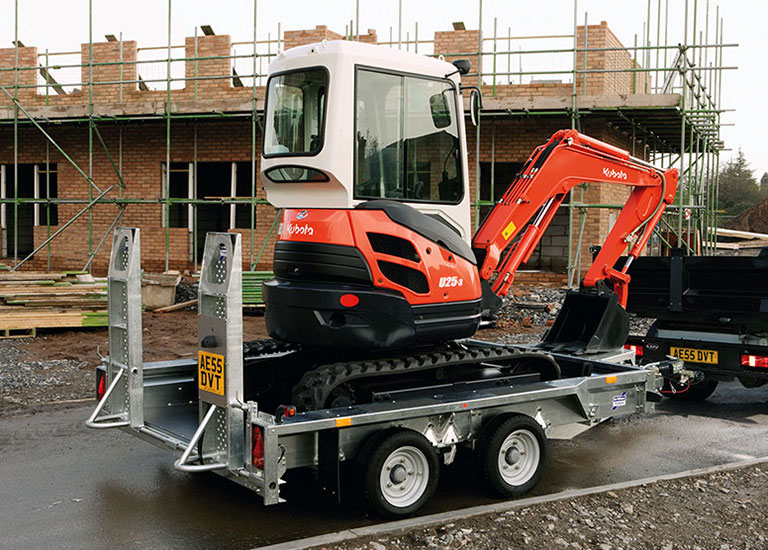
Worked example: a GX105 and a mini digger
Say your mini digger weighs 1,800 kg with its buckets, fuel and the straps that hold it down. (The machine weight is an example, for illustration.) The GX105 comes in two weight ratings:
| GX105 with skids | Gross weight | Unladen weight | Payload |
|---|---|---|---|
| Standard | 2,700 kg | 660 kg | 2,040 kg |
| HD | 3,500 kg | 670 kg | 2,830 kg |
Both carry 1,800 kg. The standard GX105 leaves 240 kg to spare; the HD leaves over 1,000 kg, which matters if you later buy a bigger machine or carry attachments. But a fully loaded HD can weigh up to 3,500 kg, so check that your vehicle’s towing limit covers what you will actually tow.
Not sure which version suits your machine? Tell us what it weighs and what you tow with.
Call 01723 355600What your vehicle can tow
Your vehicle has a towing limit, usually given in the handbook or specification sheet. Handbooks normally give one limit for a braked trailer and a lower one for an unbraked trailer. The loaded trailer must not weigh more than the limit.
There is also a gross train weight: the most that your loaded vehicle and loaded trailer may weigh together. It is often shown on the vehicle’s VIN plate, usually under the bonnet or inside the driver’s door.
No train weight on the plate?
GOV.UK says that if the VIN plate shows no train weight, the vehicle should not be used for towing.
What your licence lets you tow
For your licence, it is the trailer’s maximum authorised mass that counts (the gross weight on its plate), not what you happen to have loaded.
| When you got your car licence | What you can tow |
|---|---|
| On or after 1 January 1997 | A trailer of up to 3,500 kg MAM (category BE). If BE is not on your licence, DVLA adds it when you next renew. |
| Before 1 January 1997 | Usually a vehicle and trailer of up to 8,250 kg MAM combined. Check the categories on your licence. |
| Heavier than that | C1+E entitlement, with its own theory and driving tests, allows up to 12,000 kg MAM combined. |
So on a licence from 1997 onwards, every trailer in our plant range is within your licence, including the 3,500 kg tri-axles. Whether your vehicle can tow it is the separate check above.
Other rules when you tow
- A trailer that weighs over 750 kg loaded must have working brakes.
- Use a breakaway cable or secondary coupling every time.
- Fit towing mirrors if the trailer is wider than the back of your vehicle.
- Show the same number plate on the trailer as on the towing vehicle.
- No trailer may be wider than 2.55 metres.
- Behind a vehicle of 3,500 kg MAM or less, the trailer may be no longer than 7 metres, not counting the A-frame.
- Towing for work? If your vehicle and trailer together are rated over 3,500 kg, drivers’ hours and tachograph rules may apply. Check GOV.UK.
This guide summarises the rules as they stood on 17 October 2026. Your licence, your vehicle’s handbook and GOV.UK are what count; we are glad to check the figures with you.
Trailers in this guide


Sources
- GOV.UK, Towing with a car: what you can tow; towing weight and width limits; trailer and towing equipment. Checked 17 October 2026.
- GOV.UK, Drivers' hours: goods vehicles. Checked 17 October 2026.
- Ifor Williams Trailers, GX105 specification (iwt.co.uk). Checked 17 October 2026.
Rules change. We check each guide against its sources at least once a year; if something here no longer matches GOV.UK, GOV.UK is right, and we would be glad to hear about it.